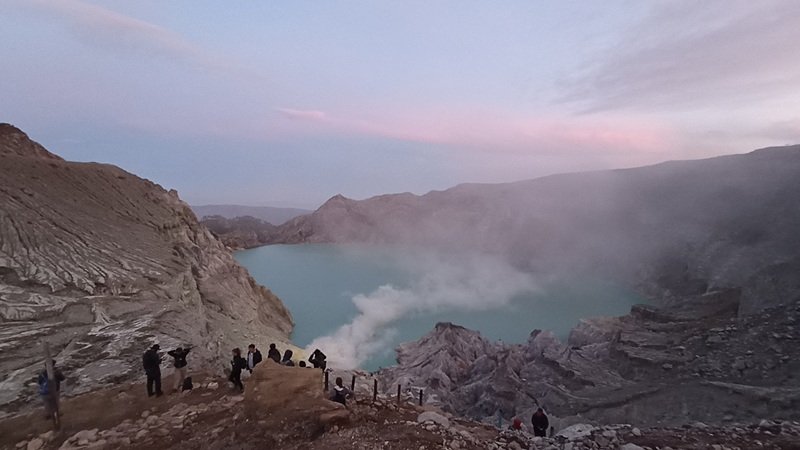
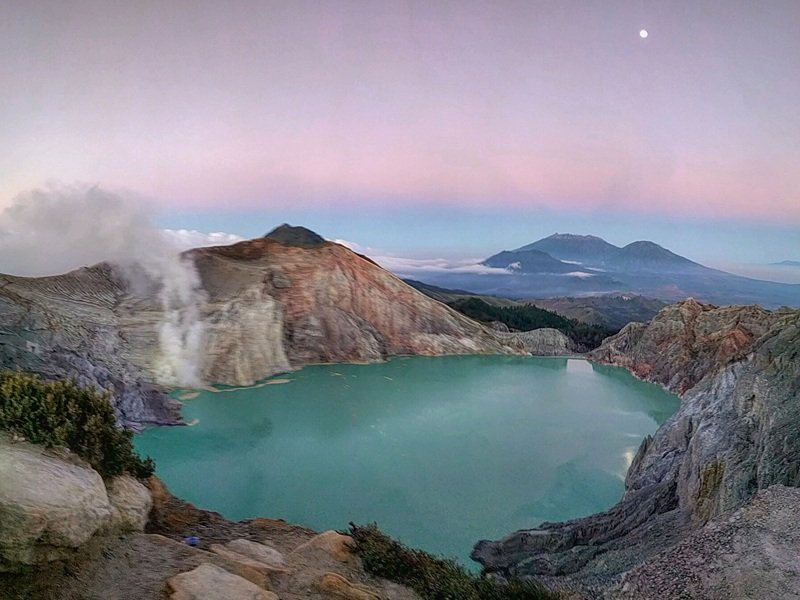
The turquoise water of Kawah Ijen looks almost artificial — too vivid, too perfectly coloured to be real. But that colour is entirely natural, and the science behind it is as extraordinary as the view. This is one of the most chemically hostile environments on Earth, and one of the most beautiful.
The World's Largest Acidic Volcanic Lake
Kawah Ijen (meaning "White Crater") holds approximately 36 million cubic metres of water — making it the world's largest acidic volcanic crater lake by volume. The water has a pH that approaches zero in some measurements, placing it among the most acidic natural bodies of water ever recorded. By comparison, battery acid has a pH of around 0.8.
The acidity is maintained by continuous volcanic hydrothermal activity. Sulfuric acid, hydrochloric acid, and other volcanic gases dissolve directly into the lake from underwater vents, keeping the chemistry constantly replenished.
Why Is It Turquoise?
The vivid blue-green colour of the lake results from the interaction of dissolved minerals with the extreme acidity. The high concentration of dissolved iron and other metals, combined with sulfuric acid saturation, scatters light in the blue-green spectrum. The colour can shift from pale jade to deep turquoise depending on sunlight angle, time of day, and current gas activity. At sunrise, the lake turns from grey to vivid blue in minutes as light hits the water.
The Blue Fire: Burning Sulfur at 600°C
The same geological processes that colour the lake produce the blue fire. At the lake's edge and along the crater walls, volcanic vents emit sulfuric gas at temperatures around 600°C. At these temperatures, the sulfur compounds combust on contact with atmospheric oxygen and burn with the characteristic blue flame — invisible in daylight, vivid in darkness.
This phenomenon — known scientifically as combustion of volcanic sulfur — occurs at only two locations on Earth: Kawah Ijen, and Dallol volcano in Ethiopia. Ijen is the only one regularly accessible to visitors.
The Sulfur Miners
Perhaps the most extraordinary — and heartbreaking — aspect of Ijen is the presence of traditional sulfur miners who have worked in the crater for generations. Each day, miners descend to the crater floor, break solid sulfur deposits from around the blue fire vents with iron rods, and carry 70–90 kg loads up the 200-meter crater wall to the rim, then several kilometres to the weighing station.
Each load earns approximately IDR 100,000–130,000 (around USD $8–10). The miners breathe volcanic fumes continuously. Most suffer from respiratory problems. Their work is considered one of the most physically demanding traditional occupations remaining in the world.
Our guides always acknowledge the miners' work on Ijen tours. Visiting the blue fire is only possible because these men have made the crater accessible. Respectful acknowledgment — not tourism gawking — is the appropriate response.
The lake water at Ijen is extremely acidic. Contact with exposed skin for more than a few seconds causes chemical burns. Do not touch, wade in, or get close enough for splash contact with the lake surface.
Ijen as a UNESCO Candidate
Kawah Ijen has been discussed as a potential UNESCO World Heritage Site due to its unique geological properties, the cultural significance of the traditional mining, and the extraordinary biodiversity of the surrounding Ijen Plateau — which hosts some of Java's last intact highland forest.
Visiting the Lake Responsibly
Stay on marked paths. The crater floor around the vents is unstable in areas — guides know the safe approach. Gas masks are not optional close to active vents. The miners work in these conditions by necessity; tourists should minimise their exposure. Always book with a guide who knows current conditions — fume intensity varies significantly with wind and volcanic activity.
Ready to Experience This Yourself?
Our guides have led 500+ travelers to East Java's most spectacular destinations. Let us plan your perfect trip.